Our work · Volkswagen Golf 1.6 TDI 115 · Stage 1
Golf 1.6 TDI 115: a calibration written from its own logs
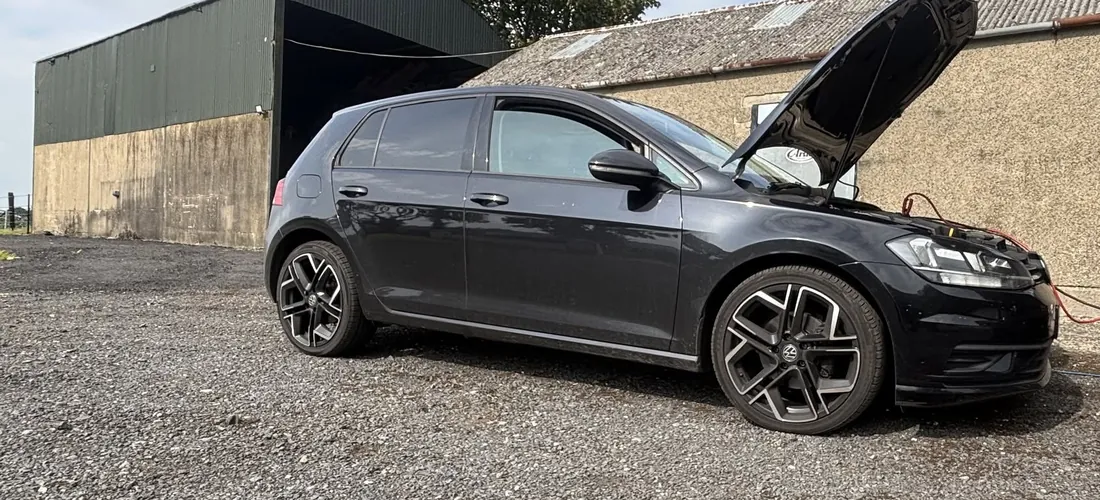
This 2019 Golf 1.6 TDI 115 shows exactly why every car we tune gets data logged. Here's a strong base file against our own calibration, written from what the logs showed, and the result is exactly what we were after: right on the figure we quoted, and a car that pulls smoothly from low down right up through the rev range!
On the road it now pulls hard from 1,750 rpm and just keeps going, with no flat spot in the middle and no fade before the top. It drives the way this engine should have left the factory.
The plan is always the same: make safe, usable power with a nice smooth torque curve. We logged the standard car and the base file, those logs showed us exactly where the engine still had room, and we wrote our own calibration from them.
What the logs showed
The standard car was healthy, and slightly strong for a 115. Like every one of these, it was being held back by its limiters, with plenty of air in the mid-range that the fuel wasn't using.
The base file (V1) did a good job of it: about 142 bhp and 280 Nm, up from about 120 bhp and 250 Nm. But its log showed two things we wanted to improve:
- Torque peaked early. It levelled off at 2,500 to 2,750 rpm and started to fade from 3,000 rpm, so the car only made its best power right at the top, around 4,100 rpm.
- The mid-range was held back by the smoke limiter, not the engine. Lambda sat at 1.21 to 1.26 from 2,000 to 3,250 rpm, so there was still clean air there for more fuel. The torque limiter would have allowed more; the smoke limiter wasn't letting it through.
What we changed for V2
V2 keeps what the logs proved was right and rewrites the rest:
- Boost targets kept. The turbo delivered the base file's boost cleanly on the log, so we left it.
- Smoke limiter reshaped, all 19 copies. This ECU stores its smoke limiter 19 times over for different conditions, and each copy has its own factory shape. We reshaped every copy from its own shape, adding fuel where the log showed clean air, in smooth steps from cell to cell. Whichever copy the ECU is using, the fuel comes in the same way.
- Injector calibration left at factory. Every extra milligram of fuel goes in through maps we can see and log, so the logs tell the truth.
- Torque to fuel, smoothed. The map that turns the requested torque into fuel now uses one smooth step for each torque level, so the extra fuel comes in evenly with no holes.
- Rail pressure up 4 % at high load, from 2,000 to 2,080 bar, blended in between 1,250 and 2,250 rpm so there's no step you can feel.
- Clutch torque limit raised to suit the extra torque on this manual car, keeping the factory shape.
V2 against the base file
Same road, same gear, and here's how the three files compare:
- Stock
- V1 (base file)
- V2 (our calibration)
Show the numbers
| rpm | Stock (Nm) | V1 (Nm) | V2 (Nm) |
|---|---|---|---|
| 1,625 | 274 | 264 | 287 |
| 1,875 | 296 | 308 | 326 |
| 2,125 | 297 | 317 | 337 |
| 2,375 | 299 | 317 | 334 |
| 2,625 | 300 | 325 | 340 |
| 2,875 | 300 | 325 | 343 |
| 3,125 | 304 | 323 | 354 |
| 3,375 | 300 | 314 | 354 |
| 3,625 | 286 | 296 | 325 |
| 3,875 | 268 | 292 | 312 |
| 4,125 | 254 | 289 | 296 |
| 4,375 | 235 | 266 | 273 |
| 4,625 | – | 241 | 231 |
- ✅ Fuel at full load: 56 to 58 mg per stroke on V1, now 60 to 64 mg from 1,750 to 3,500 rpm (standard: 47 to 50 mg)
- ✅ Torque, as the ECU reports it: peak 325 Nm on V1, now 354 Nm, holding 347 to 354 Nm from 3,000 to 3,400 rpm
- ✅ More torque than V1 at every point from 1,500 to 4,250 rpm
- ✅ Peak power now arrives at about 3,300 rpm and holds flat to about 4,300 rpm; V1 only got there at about 4,100 rpm
- ✅ Around 145 bhp and 300 Nm at the crank, worked out from the logs the same way for every file: right on the figure we quoted
- ✅ Lambda held at 1.10 or above all the way through the pull: clean, no smoke
- ✅ Exhaust temperature peak within a degree of the standard car's
You'll see all three lines ease off above 3,400 rpm. That's the turbo-speed protection easing the boost to keep the turbo inside its limits, and the standard car does exactly the same. Could we have flattened that out? Yes, by loosening the protection, but we believe the safety of your engine comes first. Power still holds flat right up to 4,300 rpm, so from the driver's seat it just keeps pulling.
All of this was done with these protections left exactly as Volkswagen set them:
- 🔒 Exhaust temperature protection
- 🔒 Injection timing
- 🔒 Injector calibration
- 🔒 Rail pressure limits for cold starts and hot fuel
Build, log, refine, until the ECU and the engine agree. In our honest opinion, you'll struggle to find a better balance of power, drivability and safety for this engine. It's now our Stage 1 for the 1.6 TDI 115 on the Delphi ECU, in the Golf, A3, Leon and Octavia, always checked against your car's own software and logged on your car.
About the figures: all three logs are 3rd-gear full-throttle pulls on the same road. The torque on the chart is the figure the ECU reports, which reads higher than at the flywheel, so the best way to read it is the gap between the lines: the bigger the gap at any rpm, the more torque, and power, the car has gained there. The crank figures are estimates from the logged data, worked out the same way for all three files.